Bypassing the Bottleneck: Architecting an AWS Express Lane for Heavy On-Premises Workloads
How we used PAN-OS Policy-Based Forwarding, selective SNAT, and an isolated Transit Gateway routing domain to bypass centralized firewall inspection for trusted high-volume database transfers—without weakening our security posture.

Here's how we built our AWS "express lane" using Palo Alto Networks PAN-OS firewalls, AWS Transit Gateway, an isolated TGW routing domain, and a dedicated Large Bandwidth Site-to-Site VPN.
The Baseline: Inspection by Default
Our AWS network follows a hub-and-spoke model with centralized firewall inspection. Two Transit Gateway route tables provide the core of the inspection architecture:
TGW-RT-TO-FW - Pre-Inspection: Standard spoke VPC and hybrid-connectivity attachments enter this routing domain and are directed toward the Security VPC.
TGW-RT-FROM-FW - Post-Inspection: The Security VPC attachment uses this table to reach the appropriate destination after inspection.
AWS Transit Gateway associates each attachment with one TGW route table, while an attachment can propagate routes into multiple route tables. That distinction is important: the associated table determines the routing policy applied to traffic entering the Transit Gateway from that attachment.
Our standard Site-to-Site VPN, VPN-A, remains the normal hybrid connectivity path. It uses standard-bandwidth AWS VPN tunnels — up to 1.25 Gbps per tunnel, with higher aggregate capacity possible through ECMP, while our Security VPC remains the default inspection point.
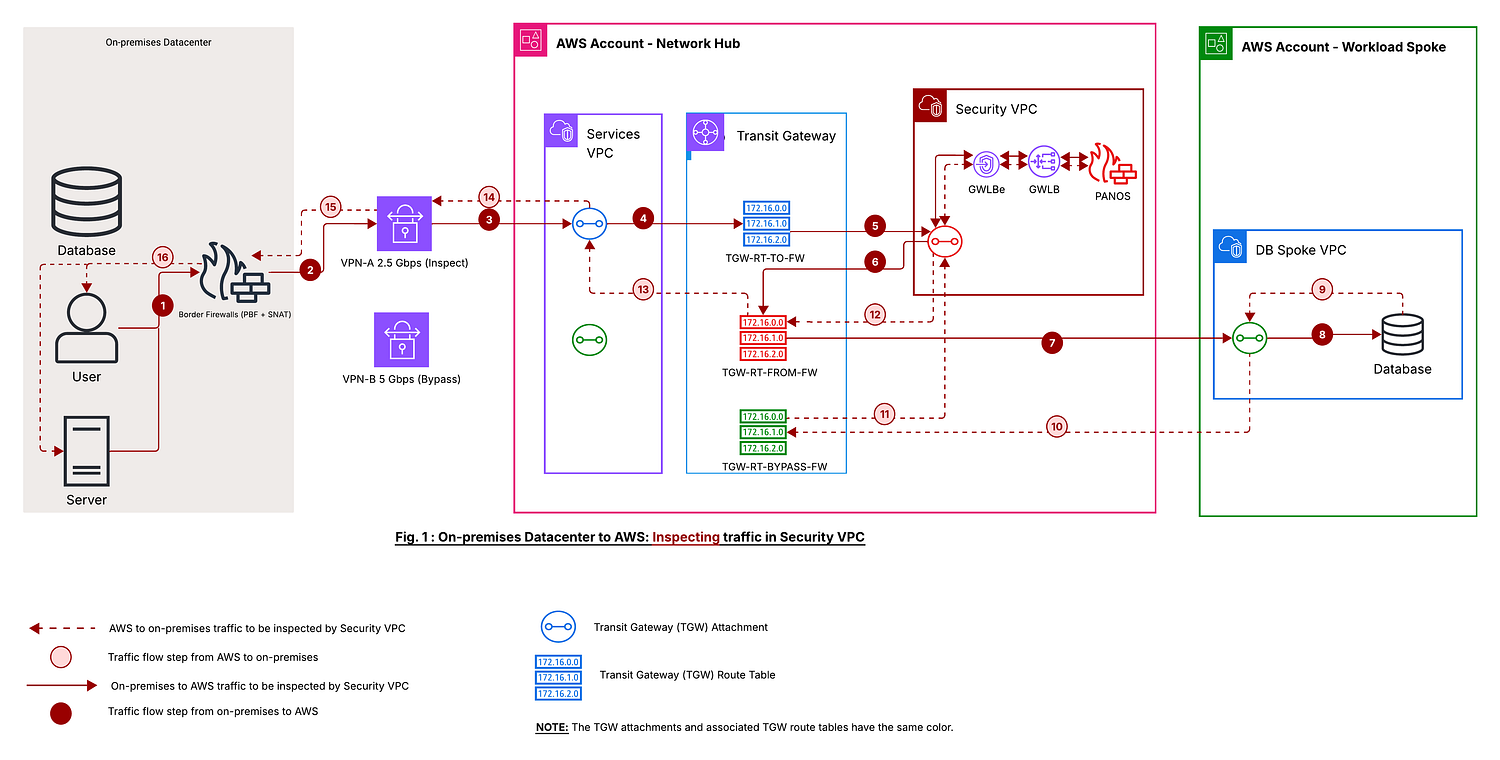
The Exception: A Dedicated High-Bandwidth VPN
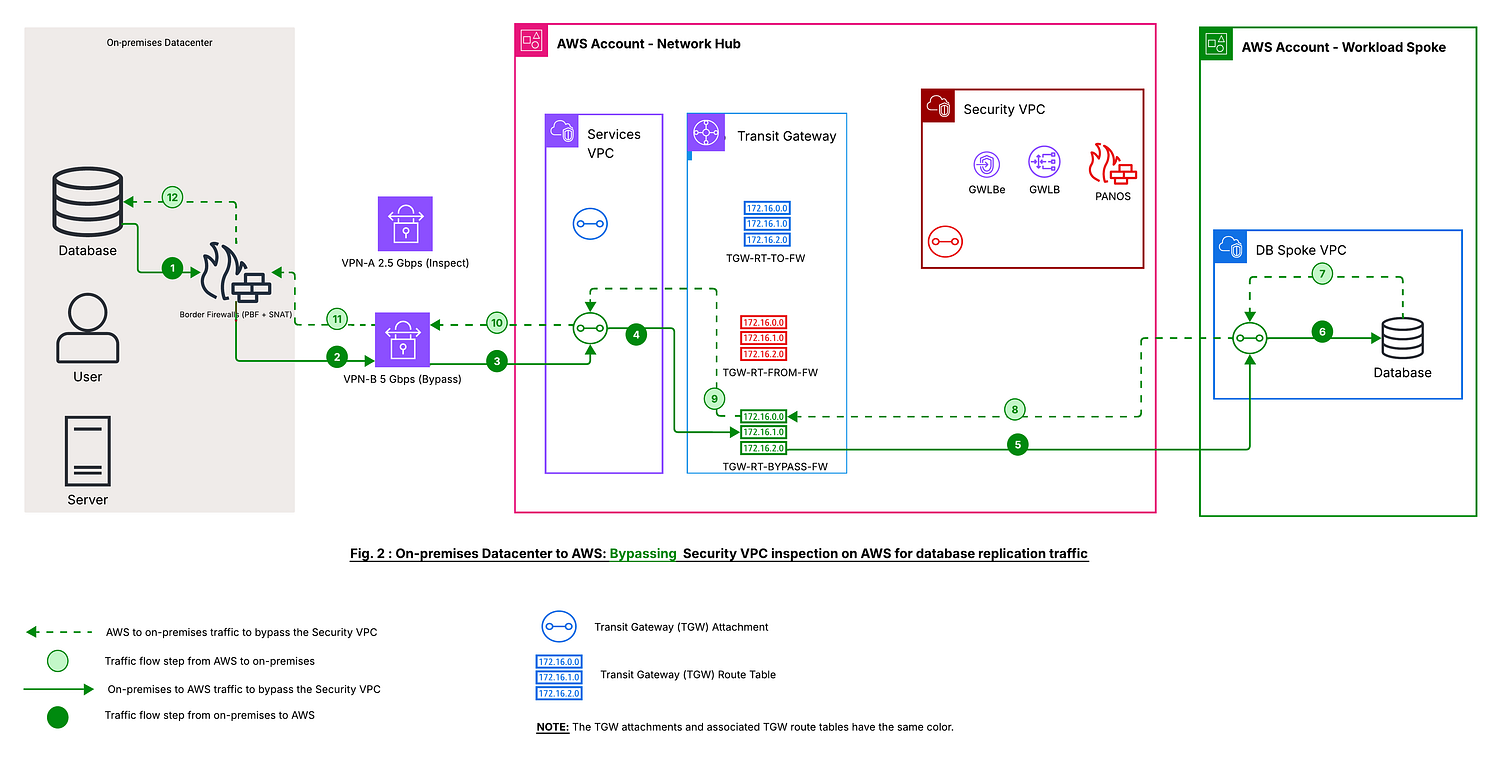
In our implementation, both the VPN-B attachment and Database VPC attachment are associated with TGW-RT-BYPASS-FW. This is an isolated TGW routing domain: the Database VPC is not generally exempt from inspection simply because it participates in a bypass path.
The governing principle is:
Bypass must be explicit. Inspection remains the default.
The Solution: PBF, SNAT and Isolated TGW Routing Domain
1. Steering the Traffic On-Premises
192.168.250.0/24
This gives bypassed traffic a unique routing identity.
Instead of AWS having to distinguish whether the original on-premises networks should return through VPN-A or VPN-B, it can simply know: 192.168.250.0/24 → VPN-B
SNAT isn't an inherent requirement of AWS Site-to-Site VPN. In our architecture it acts as a route-disambiguation mechanism, allowing us to introduce the bypass without changing the routing behavior of the original shared on-premises CIDRs.
PBF determines the path; NAT determines the translated identity. They are separate PAN-OS policy mechanisms.
2. Creating an AWS Bypass Routing Domain
We created a dedicated Transit Gateway route table: TGW-RT-BYPASS-FW
and associated both the VPN-B attachment and the Database VPC attachment with it.
The table is intentionally sparse. Conceptually:
Approved on-prem DB prefixes   → VPN-B
On-prem bypass SNAT prefix     → VPN-B
Database VPC CIDR              → Database VPC attachment
0.0.0.0/0                      → Security VPC
- The first routes implement explicit exceptions.
- The final route is the critical guardrail:
0.0.0.0/0 → Security VPC - Anything that does not match an approved bypass route goes back through our normal PAN-OS inspection architecture.
- That means a database EC2 instance attempting to communicate with an ordinary VPC, an unapproved on-premises network, or an internet destination continues through the centralized firewall path.
3. Keep the Bypass Route Table Sparse
TGW-RT-BYPASS-FW does not acquire more-specific routes that unintentionally bypass the Security VPC.
Transit Gateway propagation can automatically install attachment routes into selected route tables. Because more-specific routes beat the 0.0.0.0/0 fail-safe, blindly propagating every spoke VPC into the bypass table could silently turn: Database VPC → Application VPC into direct, uninspected communication.
AWS supports independently controlling route-table association and propagation, so we deliberately control propagation into the bypass routing domain.The rule is simple:
Only destinations explicitly approved for bypass should have more-specific routes in the bypass table. Everything else falls through to the Security VPC.
That guardrail is arguably more important than the VPN itself.
Bidirectional Traffic Is Not the Same as Bidirectional Session Initiation
Our first use case was straightforward: an on-premises Oracle system initiated a high-volume RMAN operation toward AWS. PBF selected VPN-B, SNAT assigned the dedicated bypass identity, and AWS returned traffic for that SNAT prefix through VPN-B. Conceptually:
---------------------
ON-PREMISES INITIATED
---------------------

On-prem Oracle
      |
      | PBF → VPN-B
      | SNAT → bypass prefix
      v
    VPN-B
      |
      v
AWS Oracle

---------
RETURN
---------

AWS Oracle
      |
      | destination = bypass SNAT prefix
      v
    VPN-B
      |
      v
On-prem Oracle
Consider an AWS-initiated Oracle connection:
AWS Oracle:ephemeral-port
        |
        | SYN
        v
      VPN-B
        |
        v
On-prem Oracle:1521
The response looks like:
On-prem Oracle:1521
        |
        | SYN/ACK
        v
AWS Oracle:ephemeral-port
If the on-premises PBF policy only identifies traffic by destination service — for example TCP/1521 — the SYN/ACK no longer matches that rule because its destination is an ephemeral client port. The firewall can therefore select the normal VPN-A route for the response:
AWS ---- SYN ----> VPN-B ----> On-prem

AWS <--- SYN/ACK -- VPN-A <---- On-prem
That's asymmetric routing, exactly what stateful firewalls don't want. PAN-OS documents that PBF can be applied to the initial SYN or the first SYN/ACK of a session, which is particularly relevant to this scenario.
Make PBF Endpoint-Based, Not Oracle-Port-Based
Traffic between these explicitly approved systems belongs to the high-bandwidth hybrid path.
PAN-OS supports using addresses as PBF match criteria, and Palo Alto explicitly documents that setting Service to Any causes all otherwise matching traffic to use the PBF rule.
So the cleaner PBF is conceptually:
Source:
    approved on-prem DB/OEM endpoints

Destination:
    approved AWS DB endpoints

Service:
    Any

Forwarding:
    VPN-B
Service=Anyin PBF does not meanAllow Any. PAN-OS Security Policy can still independently allow only the Oracle, RMAN, OEM, administrative, or other services actually required.
In other words:
PBF       = path
NAT       = identity
Security  = permission
This separation makes the design both simpler and easier to govern.
Completing Bidirectional Initiation
Approved real on-prem DB CIDRs → VPN-B
Bypass SNAT prefix             → VPN-B
0.0.0.0/0                      → Security VPC
This produces two valid traffic models.
For on-premises-initiated sessions:
On-premises
  → PBF
  → SNAT
  → VPN-B
  → AWS

AWS
  → bypass SNAT prefix
  → VPN-B
  → On-premises
For AWS-initiated sessions:
AWS
  → real on-prem DB prefix
  → VPN-B
  → On-premises

On-premises
  → endpoint-based PBF
  → VPN-B
  → AWS
Both sides can initiate, and both directions remain on VPN-B.
The Result
Don't encode a workload-routing policy as a growing list of application ports when the real policy is about trusted endpoints.